v2.6 · July 2026
Heterogeneous AI Computing Virtualization Middleware
HAMi shares a GPU in two modes. Standard mode (HAMi-core) intercepts CUDA calls in software, no container changes needed. MIG mode hands out hardware partitions of the GPU.
How HAMi schedules GPU workloads across heterogeneous clusters
Single-node to multi-cluster scaling patterns
Benchmarks: throughput, latency, GPU utilization
Q3 2026 priorities and community contributions
> HAMi reduces GPU fragmentation by 40% in production inference clusters
HAMi intercepts CUDA API calls at the library level to enable fine-grained GPU sharing. The scheduler runs as a Kubernetes device plugin and supports MIG, MPS, and time-slicing for NVIDIA GPUs.
cuInit, cuMemAlloc, cuLaunchKernel

HAMi demonstrates near-linear scaling with concurrent inference workloads across 8× A100 GPUs. The key metric is GPU utilization efficiency -- HAMi achieves 92% average utilization vs. 65% baseline with default Kubernetes scheduling.
Standalone: Single binary with embedded etcd, suitable for edge inference
Monitoring: Prometheus metrics for GPU utilization, memory pressure, scheduling latency
| Resource | Minimum | Recommended | Maximum |
|---|---|---|---|
| GPUs per node | 1 | 8 | 16 |
| GPU memory (GB) | 4 | 40 | 80 |
| CPU cores | 2 | 8 | 32 |
| System RAM (GB) | 8 | 64 | 512 |
| Nodes per cluster | 1 | 10 | 100 |
| Concurrent workloads | 1 | 50 | 200 |
Accepted Q1 2026. Currently in incubation review with 12 maintainers across 6 organizations.
Native support for PyTorch, TensorFlow, vLLM, TGI, Ollama. One-click integration with KServe and Ray Serve.
850+ GitHub stars, 120 contributors, monthly community calls, Slack with 2k+ members.
Production deployments at ByteDance, Alibaba Cloud, Xiaohongshu, and 15+ Fortune 500 companies.
GPU utilization at 65%, idle GPUs
across the cluster, manual bin-packing
required for each workload
GPU utilization at 92%, automatic
fractional allocation, zero manual
intervention needed
| Feature | Open Source | Enterprise |
|---|---|---|
| GPU sharing | ✓ | ✓ |
| Fractional GPU | ✓ | ✓ |
| MIG support | ✓ | ✓ |
| Multi-cluster federation | - | ✓ |
| SSO / RBAC | - | ✓ |
| Audit logging | - | ✓ |
| SLA guarantee | - | ✓ |
| 24/7 support | Community | Dedicated |
helm repo add hami https://project-hami.github.io/charts
helm install hami hami/hami \
--set devicePlugin.version=v2.6.0 \
--set scheduler.enabled=true
Deploy HAMi with a single Helm command. The device plugin registers GPU resources and the scheduler handles workload placement. Requires Kubernetes 1.24+ and NVIDIA GPU operator.
Request GPU resources via standard Kubernetes resource limits. HAMi supports fractional allocation down to 1% of a GPU and memory limits in MiB. No container modification required.
apiVersion: v1
kind: Pod
metadata:
name: inference-test
spec:
containers:
- name: bert
image: hami-demo/bert-inference:latest
resources:
limits:
nvidia.com/gpu: 1
nvidia.com/gpumem: 8000
HAMi v2.6 supports fractional GPU with memory limits in MiB
HAMi routes GPU requests through device plugins, custom scheduling, and library-level CUDA interception. The hot path (inference) bypasses the scheduler entirely after initial placement.
Operational cost improvement
GPU utilization improvement
Workload density per GPU
Average GPU utilization
Live migration of GPU workloads between nodes without service interruption
Reduce GPU costs by 40-60% through intelligent bin-packing and fractional allocation
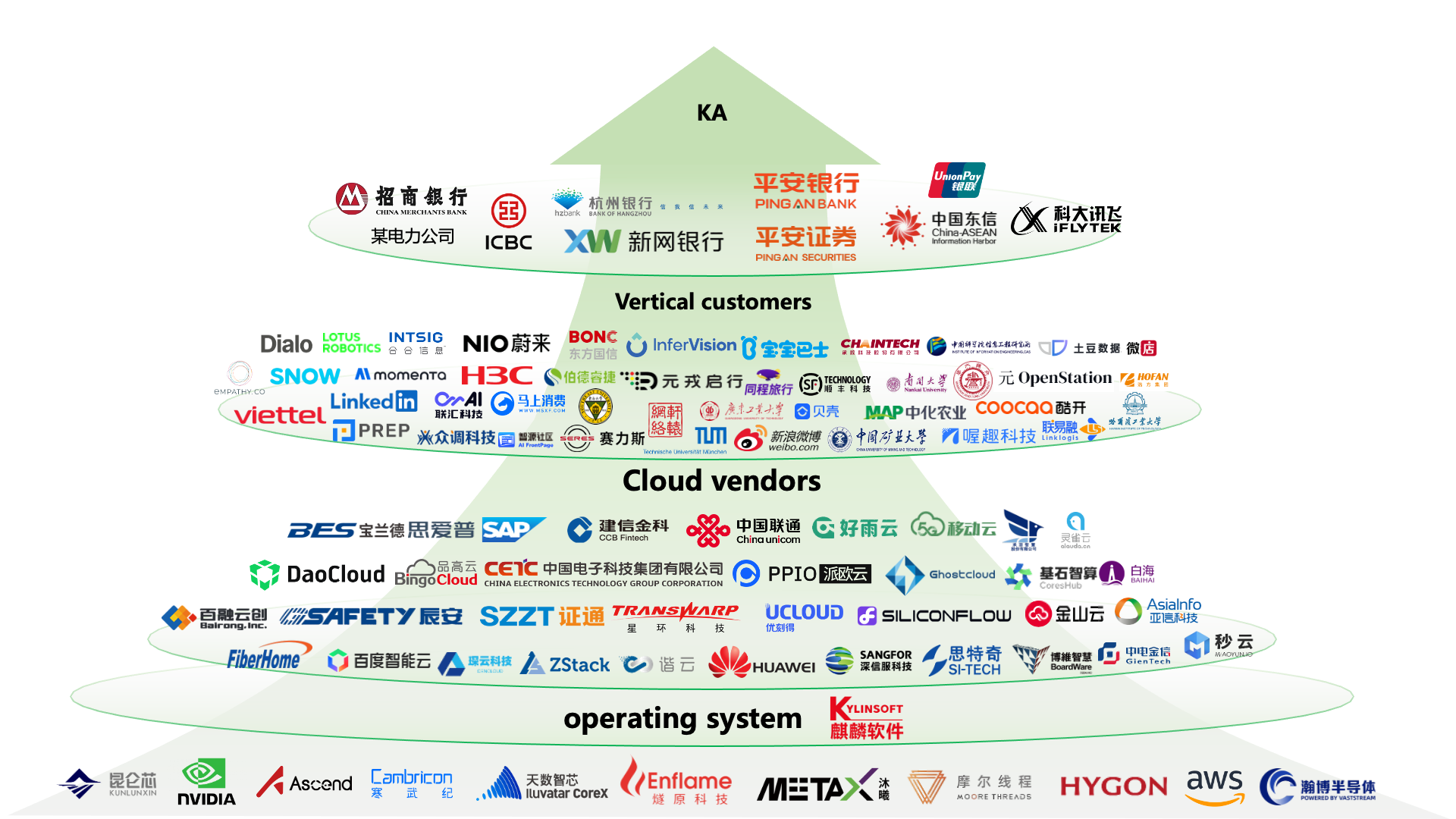
Apache 2.0 license, vendor-neutral governance, CNCF-hosted project infrastructure
{icon:star} syntax inline in text paragraphs and tables.
| Icon | Check |
|---|---|
| Pass | |
| Fail | |
| Warn |
End-to-end encrypted by default. SOC 2 Type II certified infrastructure.
Sub-millisecond P99 latency. 99.99% uptime SLA with automatic failover.
Multi-region active-active deployment. Zero-downtime rolling updates.
| Feature | Open Source | Enterprise |
|---|---|---|
| Core engine | ||
| Community support | ||
| SLA guarantees | ||
| SSO / SAML | ||
| Audit logging | ||
| RBAC | ||
| Priority fixes | ||
| Dedicated support |
@layout metrics: big numbers with a source line
Hardware pool utilization
Ke Holdings
GPU utilization in CI
NIO
Fewer GPU hours
China Merchants Bank
Device types
NVIDIA, Ascend, Cambricon, ...
@layout timeline-horizontal with {label=...} cards; ::: notes underneath
Find the 5-15% jobs
Memory + compute
Your scheduler
SKUs + quotas
Upgrades, usage
@layout ecosystem: #### section labels over metric rows and logo cards
GitHub stars
Docker pulls
Contributors

nvidia.com/gpumem in a pod::: card {blueprint} around a ```pdg diagram; this slide has @transition none
{
"nvidia.com/gpu": 1,
"nvidia.com/gpumem": 3000,
"nvidia.com/gpucores": 30
}
$ nvidia-smi
| 0 NVIDIA H200 3000MiB / 3000MiB 30% |
@video plays in the HTML deck; PDF shows the poster image next to the clip
@video assets/demo/llm_test.mp4
llm_test.png next to the clip as its poster and print image@contributor sits beside @speaker; both take github, linkedin, twitter, email, website

v2.6 · July 2026
Heterogeneous AI Computing Virtualization Middleware
HAMi shares a GPU in two modes. Standard mode (HAMi-core) intercepts CUDA calls in software, no container changes needed. MIG mode hands out hardware partitions of the GPU.
How HAMi schedules GPU workloads across heterogeneous clusters
Single-node to multi-cluster scaling patterns
Benchmarks: throughput, latency, GPU utilization
Q3 2026 priorities and community contributions
> HAMi reduces GPU fragmentation by 40% in production inference clusters
HAMi intercepts CUDA API calls at the library level to enable fine-grained GPU sharing. The scheduler runs as a Kubernetes device plugin and supports MIG, MPS, and time-slicing for NVIDIA GPUs.
cuInit, cuMemAlloc, cuLaunchKernel

HAMi demonstrates near-linear scaling with concurrent inference workloads across 8× A100 GPUs. The key metric is GPU utilization efficiency -- HAMi achieves 92% average utilization vs. 65% baseline with default Kubernetes scheduling.
Standalone: Single binary with embedded etcd, suitable for edge inference
Monitoring: Prometheus metrics for GPU utilization, memory pressure, scheduling latency
| Resource | Minimum | Recommended | Maximum |
|---|---|---|---|
| GPUs per node | 1 | 8 | 16 |
| GPU memory (GB) | 4 | 40 | 80 |
| CPU cores | 2 | 8 | 32 |
| System RAM (GB) | 8 | 64 | 512 |
| Nodes per cluster | 1 | 10 | 100 |
| Concurrent workloads | 1 | 50 | 200 |
Accepted Q1 2026. Currently in incubation review with 12 maintainers across 6 organizations.
Native support for PyTorch, TensorFlow, vLLM, TGI, Ollama. One-click integration with KServe and Ray Serve.
850+ GitHub stars, 120 contributors, monthly community calls, Slack with 2k+ members.
Production deployments at ByteDance, Alibaba Cloud, Xiaohongshu, and 15+ Fortune 500 companies.
GPU utilization at 65%, idle GPUs
across the cluster, manual bin-packing
required for each workload
GPU utilization at 92%, automatic
fractional allocation, zero manual
intervention needed
| Feature | Open Source | Enterprise |
|---|---|---|
| GPU sharing | ✓ | ✓ |
| Fractional GPU | ✓ | ✓ |
| MIG support | ✓ | ✓ |
| Multi-cluster federation | - | ✓ |
| SSO / RBAC | - | ✓ |
| Audit logging | - | ✓ |
| SLA guarantee | - | ✓ |
| 24/7 support | Community | Dedicated |
helm repo add hami https://project-hami.github.io/charts
helm install hami hami/hami \
--set devicePlugin.version=v2.6.0 \
--set scheduler.enabled=true
Deploy HAMi with a single Helm command. The device plugin registers GPU resources and the scheduler handles workload placement. Requires Kubernetes 1.24+ and NVIDIA GPU operator.
Request GPU resources via standard Kubernetes resource limits. HAMi supports fractional allocation down to 1% of a GPU and memory limits in MiB. No container modification required.
apiVersion: v1
kind: Pod
metadata:
name: inference-test
spec:
containers:
- name: bert
image: hami-demo/bert-inference:latest
resources:
limits:
nvidia.com/gpu: 1
nvidia.com/gpumem: 8000
HAMi v2.6 supports fractional GPU with memory limits in MiB
HAMi routes GPU requests through device plugins, custom scheduling, and library-level CUDA interception. The hot path (inference) bypasses the scheduler entirely after initial placement.
Operational cost improvement
GPU utilization improvement
Workload density per GPU
Average GPU utilization
Live migration of GPU workloads between nodes without service interruption
Reduce GPU costs by 40-60% through intelligent bin-packing and fractional allocation

Apache 2.0 license, vendor-neutral governance, CNCF-hosted project infrastructure
{icon:star} syntax inline in text paragraphs and tables.
| Icon | Check |
|---|---|
| Pass | |
| Fail | |
| Warn |
End-to-end encrypted by default. SOC 2 Type II certified infrastructure.
Sub-millisecond P99 latency. 99.99% uptime SLA with automatic failover.
Multi-region active-active deployment. Zero-downtime rolling updates.
| Feature | Open Source | Enterprise |
|---|---|---|
| Core engine | ||
| Community support | ||
| SLA guarantees | ||
| SSO / SAML | ||
| Audit logging | ||
| RBAC | ||
| Priority fixes | ||
| Dedicated support |
@layout metrics: big numbers with a source line
Hardware pool utilization
Ke Holdings
GPU utilization in CI
NIO
Fewer GPU hours
China Merchants Bank
Device types
NVIDIA, Ascend, Cambricon, ...
@layout timeline-horizontal with {label=...} cards; ::: notes underneath
Find the 5-15% jobs
Memory + compute
Your scheduler
SKUs + quotas
Upgrades, usage
@layout ecosystem: #### section labels over metric rows and logo cards
GitHub stars
Docker pulls
Contributors

nvidia.com/gpumem in a pod::: card {blueprint} around a ```pdg diagram; this slide has @transition none
{
"nvidia.com/gpu": 1,
"nvidia.com/gpumem": 3000,
"nvidia.com/gpucores": 30
}
$ nvidia-smi
| 0 NVIDIA H200 3000MiB / 3000MiB 30% |
@video plays in the HTML deck; PDF shows the poster image next to the clip
@video assets/demo/llm_test.mp4
llm_test.png next to the clip as its poster and print image@contributor sits beside @speaker; both take github, linkedin, twitter, email, website

v2.6 · July 2026
Heterogeneous AI Computing Virtualization Middleware
HAMi shares a GPU in two modes. Standard mode (HAMi-core) intercepts CUDA calls in software, no container changes needed. MIG mode hands out hardware partitions of the GPU.
How HAMi schedules GPU workloads across heterogeneous clusters
Single-node to multi-cluster scaling patterns
Benchmarks: throughput, latency, GPU utilization
Q3 2026 priorities and community contributions
> HAMi reduces GPU fragmentation by 40% in production inference clusters
HAMi intercepts CUDA API calls at the library level to enable fine-grained GPU sharing. The scheduler runs as a Kubernetes device plugin and supports MIG, MPS, and time-slicing for NVIDIA GPUs.
cuInit, cuMemAlloc, cuLaunchKernel

HAMi demonstrates near-linear scaling with concurrent inference workloads across 8× A100 GPUs. The key metric is GPU utilization efficiency -- HAMi achieves 92% average utilization vs. 65% baseline with default Kubernetes scheduling.
Standalone: Single binary with embedded etcd, suitable for edge inference
Monitoring: Prometheus metrics for GPU utilization, memory pressure, scheduling latency
| Resource | Minimum | Recommended | Maximum |
|---|---|---|---|
| GPUs per node | 1 | 8 | 16 |
| GPU memory (GB) | 4 | 40 | 80 |
| CPU cores | 2 | 8 | 32 |
| System RAM (GB) | 8 | 64 | 512 |
| Nodes per cluster | 1 | 10 | 100 |
| Concurrent workloads | 1 | 50 | 200 |
Accepted Q1 2026. Currently in incubation review with 12 maintainers across 6 organizations.
Native support for PyTorch, TensorFlow, vLLM, TGI, Ollama. One-click integration with KServe and Ray Serve.
850+ GitHub stars, 120 contributors, monthly community calls, Slack with 2k+ members.
Production deployments at ByteDance, Alibaba Cloud, Xiaohongshu, and 15+ Fortune 500 companies.
GPU utilization at 65%, idle GPUs
across the cluster, manual bin-packing
required for each workload
GPU utilization at 92%, automatic
fractional allocation, zero manual
intervention needed
| Feature | Open Source | Enterprise |
|---|---|---|
| GPU sharing | ✓ | ✓ |
| Fractional GPU | ✓ | ✓ |
| MIG support | ✓ | ✓ |
| Multi-cluster federation | - | ✓ |
| SSO / RBAC | - | ✓ |
| Audit logging | - | ✓ |
| SLA guarantee | - | ✓ |
| 24/7 support | Community | Dedicated |
helm repo add hami https://project-hami.github.io/charts
helm install hami hami/hami \
--set devicePlugin.version=v2.6.0 \
--set scheduler.enabled=true
Deploy HAMi with a single Helm command. The device plugin registers GPU resources and the scheduler handles workload placement. Requires Kubernetes 1.24+ and NVIDIA GPU operator.
Request GPU resources via standard Kubernetes resource limits. HAMi supports fractional allocation down to 1% of a GPU and memory limits in MiB. No container modification required.
apiVersion: v1
kind: Pod
metadata:
name: inference-test
spec:
containers:
- name: bert
image: hami-demo/bert-inference:latest
resources:
limits:
nvidia.com/gpu: 1
nvidia.com/gpumem: 8000
HAMi v2.6 supports fractional GPU with memory limits in MiB
HAMi routes GPU requests through device plugins, custom scheduling, and library-level CUDA interception. The hot path (inference) bypasses the scheduler entirely after initial placement.
Operational cost improvement
GPU utilization improvement
Workload density per GPU
Average GPU utilization
Live migration of GPU workloads between nodes without service interruption
Reduce GPU costs by 40-60% through intelligent bin-packing and fractional allocation

Apache 2.0 license, vendor-neutral governance, CNCF-hosted project infrastructure
{icon:star} syntax inline in text paragraphs and tables.
| Icon | Check |
|---|---|
| Pass | |
| Fail | |
| Warn |
End-to-end encrypted by default. SOC 2 Type II certified infrastructure.
Sub-millisecond P99 latency. 99.99% uptime SLA with automatic failover.
Multi-region active-active deployment. Zero-downtime rolling updates.
| Feature | Open Source | Enterprise |
|---|---|---|
| Core engine | ||
| Community support | ||
| SLA guarantees | ||
| SSO / SAML | ||
| Audit logging | ||
| RBAC | ||
| Priority fixes | ||
| Dedicated support |
@layout metrics: big numbers with a source line
Hardware pool utilization
Ke Holdings
GPU utilization in CI
NIO
Fewer GPU hours
China Merchants Bank
Device types
NVIDIA, Ascend, Cambricon, ...
@layout timeline-horizontal with {label=...} cards; ::: notes underneath
Find the 5-15% jobs
Memory + compute
Your scheduler
SKUs + quotas
Upgrades, usage
@layout ecosystem: #### section labels over metric rows and logo cards
GitHub stars
Docker pulls
Contributors

nvidia.com/gpumem in a pod::: card {blueprint} around a ```pdg diagram; this slide has @transition none
{
"nvidia.com/gpu": 1,
"nvidia.com/gpumem": 3000,
"nvidia.com/gpucores": 30
}
$ nvidia-smi
| 0 NVIDIA H200 3000MiB / 3000MiB 30% |
@video plays in the HTML deck; PDF shows the poster image next to the clip
@video assets/demo/llm_test.mp4
llm_test.png next to the clip as its poster and print image@contributor sits beside @speaker; both take github, linkedin, twitter, email, website